How to Clean Anti-Reflective Lenses Without Ruining the Coating
Disclosure: This post contains affiliate links. If you click one of these links and make a purchase (for example, on Amazon), we earn a commission at no extra cost to you. As an independent UK price comparison service, we only recommend products and retailers we genuinely trust.
We have all done it. You catch a massive, blurry fingerprint right in the centre of your frame and need to know how to clean anti reflective lenses fast. You don’t have a cloth nearby, so you resort to the old faithful options: a quick huff of breath, a bit of spit, or rubbing them against the hem of your t-shirt. Some of us have even been tempted to pop them into the top rack of the dishwasher during a deep clean!
While those quick fixes might clear the smudge for a second, they are secretly destroying your eyewear. Anti-reflective (AR) specs require a specific touch. If you don’t know how to clean anti-reflective lenses safely, you risk permanently stripping or scratching the microscopically thin performance layers that keep your vision sharp.
Here is everything you need to know to keep your premium lenses crystal clear without causing accidental damage.
Why Anti-Reflective Coatings Need Special Care
To understand why traditional cleaning habits fail, it helps to understand what is actually on your lenses. Anti-glare or anti-reflective coatings aren’t built into the glass or plastic; they are baked onto the surface in ultra-thin layers of metallic oxides.
Because these layers are incredibly delicate, common household habits wreak havoc on them:
- The “Spit and T-Shirt” Method: Human saliva contains enzymes, and your casual cotton t-shirt acts like fine sandpaper on an optical coating. Dry-wiping dirt into the lens permanently micro-scratches the surface.
- The Dishwasher Disaster: It sounds like the ultimate lazy-clean hack, but the intense heat of a dishwasher cycle causes the lens material and the AR coating to expand at completely different rates. This leads to “crazing” – web of permanent, microscopic cracks that looks like shattered glass and ruins your vision.
- Washing-Up Liquid: Standard kitchen soaps frequently contain harsh citrus extracts or abrasive salts that chemically strip away the metallic oxides over time.
When you calculate how much glasses cost in the UK, premium lens treatments like anti-reflective coatings are often a significant add-on at high-street opticians. Protecting that investment from the start saves you a fortune in early replacements.
How to Clean Anti Reflective Lenses Safely: Step-by-Step
Follow this foolproof, optician-approved routine to remove oil, grease, and dust without endangering your coatings:
1. Rinse Under Lukewarm Water
Before you ever touch the lens with a cloth, run them under a gentle stream of lukewarm tap water. This instantly flushes away loose dust, sand, and grit particles. Crucial tip: Ensure the water is never hot, as extreme heat instantly warps and cracks the AR film.
2. Clean Anti Reflective Lenses With a Dedicated Spray
Mist both sides of each lens with a dedicated, alcohol-free cleaning solution. These formulas are pH-neutral and specially balanced to break down skin oils without degrading the metallic oxide layers.
3. Wipe with a Clean Microfibre Cloth
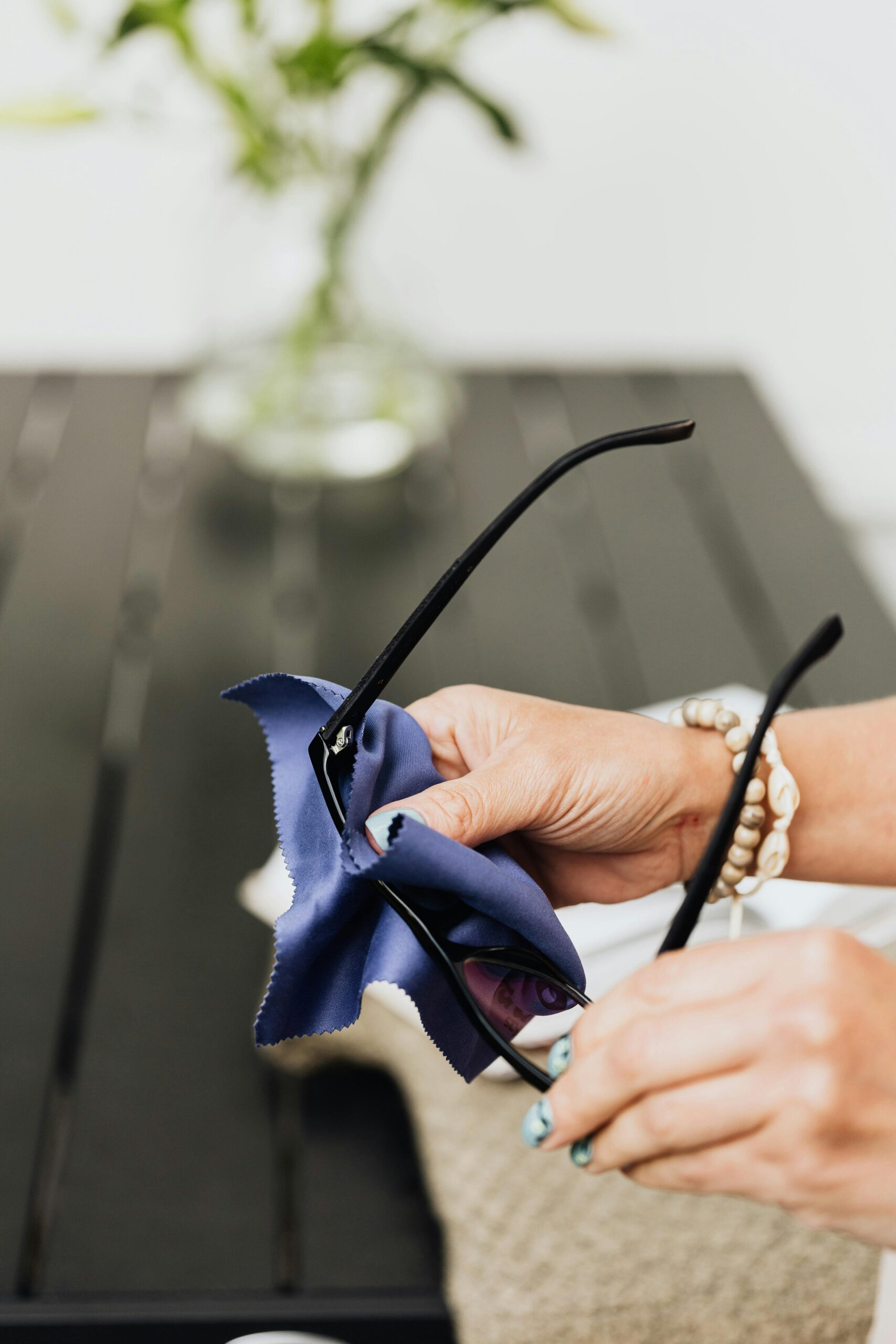
Gently wipe the lenses using a clean, high-quality microfibre cloth. Move the cloth firmly in circular motions from the outside edge of the frame inward. Never use kitchen roll, tissues, or toilet paper – these are made from wood pulp and will micro-scratch your specs instantly.
The Best Accessories for Anti-Reflective Lens Maintenance
If you want to keep your glasses pristine on the go without relying on your sleeve, a few small, specialised maintenance tools are well worth keeping in your bag.
1. Professional AR-Safe Lens Cleaning Sprays
Using a formula explicitly labeled “AR-Safe” ensures you aren’t applying hidden alcohol or ammonia to your eyewear. Keeping a travel-sized bottle in your car or bag prevents emergency dry-wiping.
- Recommended: Calocloth or Zeiss Lens Spray Kit
2. High-Quality Microfibre Cleaning Cloths
An old microfibre cloth that has been sitting at the bottom of a bag traps grit and redistributes grease. Buying a cheap multipack allows you to rotate them regularly and wash them safely without fabric softener.
- Recommended: Multipack of Optical Microfibre Cloths
3. Ultrasonic Eyewear Cleaning Pods
If you want the ultimate deep clean without any abrasive rubbing, a domestic ultrasonic pod is incredible. It uses high-frequency sound waves and plain water to safely vibrate skin oils and debris right out of the lens rims and nose pads.
- Recommended: Compact Ultrasonic Eyewear Cleaner
Common Mistakes to Avoid
To keep your glasses lasting for years, keep these three golden rules in mind:
- Never use household glass cleaner: Commercial sprays like Windolene contain ammonia or alcohol designed for windows, which will chemically dissolve optical coatings.
- Skip the fabric softener: When washing your microfibre cloths, never use fabric softener. It leaves a chemical residue on the fabric that causes permanent streaks on your specs next time you use them.
- Avoid the heat: Never leave your glasses face-up on a sunny car dashboard. The concentrated heat can cause the coating to distort and peel.
Ready to Upgrade Your Specs?
Keeping your current glasses pristine is step one, but if you’ve been trying to figure out how to clean anti reflective lenses because yours are already permanently scratched or crazed, it might be time to see what a fresh pair actually costs.
Takes 60 seconds • 100% free • No sign-up required