Myopia Control Lenses: How Do They Actually Work?
If you’ve read our guides to what myopia is and what causes it, you’ll know that standard glasses correct a child’s vision without doing anything to slow the underlying cause. Myopia control lenses are different: they’re specifically designed to slow how fast a child’s eye continues to elongate, not just correct the blur.
Why Standard Glasses Don’t Slow Myopia Progression
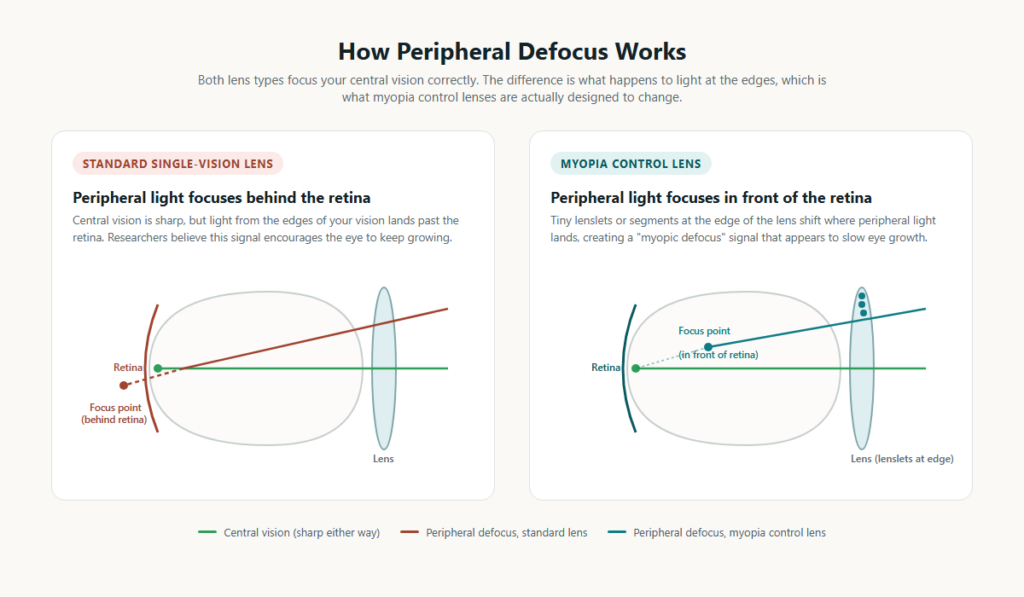
Ordinary single-vision lenses do a good job focusing light correctly on the central retina, where you actually look. But at the edges of your vision, they let light focus slightly behind the retina instead. Researchers believe this peripheral signal, called hyperopic defocus, is part of what tells a growing eye to keep elongating. Myopia control lenses all work on the same underlying principle, however different they look: shift that peripheral focus point to sit in front of the retina instead, and the growth signal seems to weaken.
Myopia Control Spectacle Lenses: DIMS and HAL Technology
Two spectacle lens designs currently lead the evidence base, and they take slightly different approaches to the same idea.
DIMS (Defocus Incorporated Multiple Segments), used in Hoya’s MiYOSMART lens, has a clear central zone for normal distance vision surrounded by 400 small segments in the lens periphery, each adding extra positive power.
HAL (Highly Aspherical Lenslets), used in Essilor’s Stellest lens, takes a denser approach: 1,021 aspherical lenslets arranged in 11 concentric rings around the central zone, with the defocus effect increasing further from the centre.
A two-year comparative study found both genuinely slow eye growth, and the difference between the two wasn’t statistically significant, so DIMS and HAL work comparably well. That’s actually useful to know: the choice between them tends to come down to things like cost, fit, and what your optician actually stocks, not one being clearly superior.
How MiSight Contact Lenses Work
For children (or parents) who’d rather avoid glasses, MiSight is a daily disposable contact lens using the same underlying principle in a different form: concentric rings alternating between your normal correction and a peripheral myopic-defocus zone. In long-term trials, MiSight slowed progression by around 50%, and children who stayed on the study showed no meaningful catch-up progression even six years in. It’s been available in the UK since 2020.
Orthokeratology: The Overnight Option
Orthokeratology (ortho-k) works completely differently from the other three. Instead of being worn during the day, rigid gas-permeable lenses are worn overnight, gently reshaping the cornea while you sleep, flattening it centrally and steepening it slightly at the mid-periphery. That reshaping does two things at once: it corrects vision for the following day without needing to wear anything, and it creates the same kind of peripheral myopic defocus signal as the other options.
Which Type of Myopia Control Is Right for Your Child?
All four options are working toward the same goal by different routes, and none of them is simply “better” in the abstract, it depends on your child’s age, prescription, and what they’ll actually wear consistently, since none of these work if they’re left in a drawer. Our guide to choosing a myopia control lens covers exactly that decision, including what things actually cost in the UK.